


Most companies think they need an AI policy—an AI policy that actually sticks.
What they actually need is a way to enable and empower their employees to get the best out of AI tools without exposing the company to unneeded risk.
Obviously, AI isn’t sitting on the sidelines anymore. It’s in the starting lineup. It’s everywhere! It’s already woven into how your team works—drafting emails, summarizing reports, writing code, speeding up decisions. And often without much oversight.
The companies that are getting this right aren’t writing longer documents or tighter rules. They’re building systems that reflect how work actually happens—and guiding it in the right direction.
For those in the weeds with AI policy creation, we made this getting-started guide to point you in the right direction as you navigate AI usage within your company.
~
Note: We’ve created an AI policy boilerplate for PRMT clients to adapt and apply at their companies. Want a sample? Send us an email and ask for the AI policy template.
~
1. Start With What’s Already Happening
If you try to design AI governance from scratch, you’ll miss the most important input: your own team.
Every department has already figured out where AI fits, and every employee already has their own unique take on the tools they love and the tools they’re trying out. Marketing is experimenting with content. Finance is using it to summarize reports. Operations is finding ways to automate repetitive work.
Some of this is approved.
A lot of it isn’t!
That’s not a failure—it’s insight. It shows you where AI is already creating value and where your current environment isn’t keeping up.
Before you define rules, get a clear picture of reality:
- Where AI is being used today
- Which tools are in play (approved or not)
- What kinds of data are being shared or processed
This step matters more than anything that comes after. If you don’t start here, you’re designing governance for a version of your business that doesn’t exist.
2. Create a Tiered System of Risk
One of the fastest ways to lose adoption is to treat all AI usage the same.
Not every use case carries the same weight, and your policy should reflect that.
A practical way to think about it is in tiers:
- Low risk: Drafting internal content, brainstorming ideas, working with public information
- Medium risk: Summarizing internal documents, supporting operational workflows
- High risk: Handling customer data, financial analysis, regulated or sensitive information
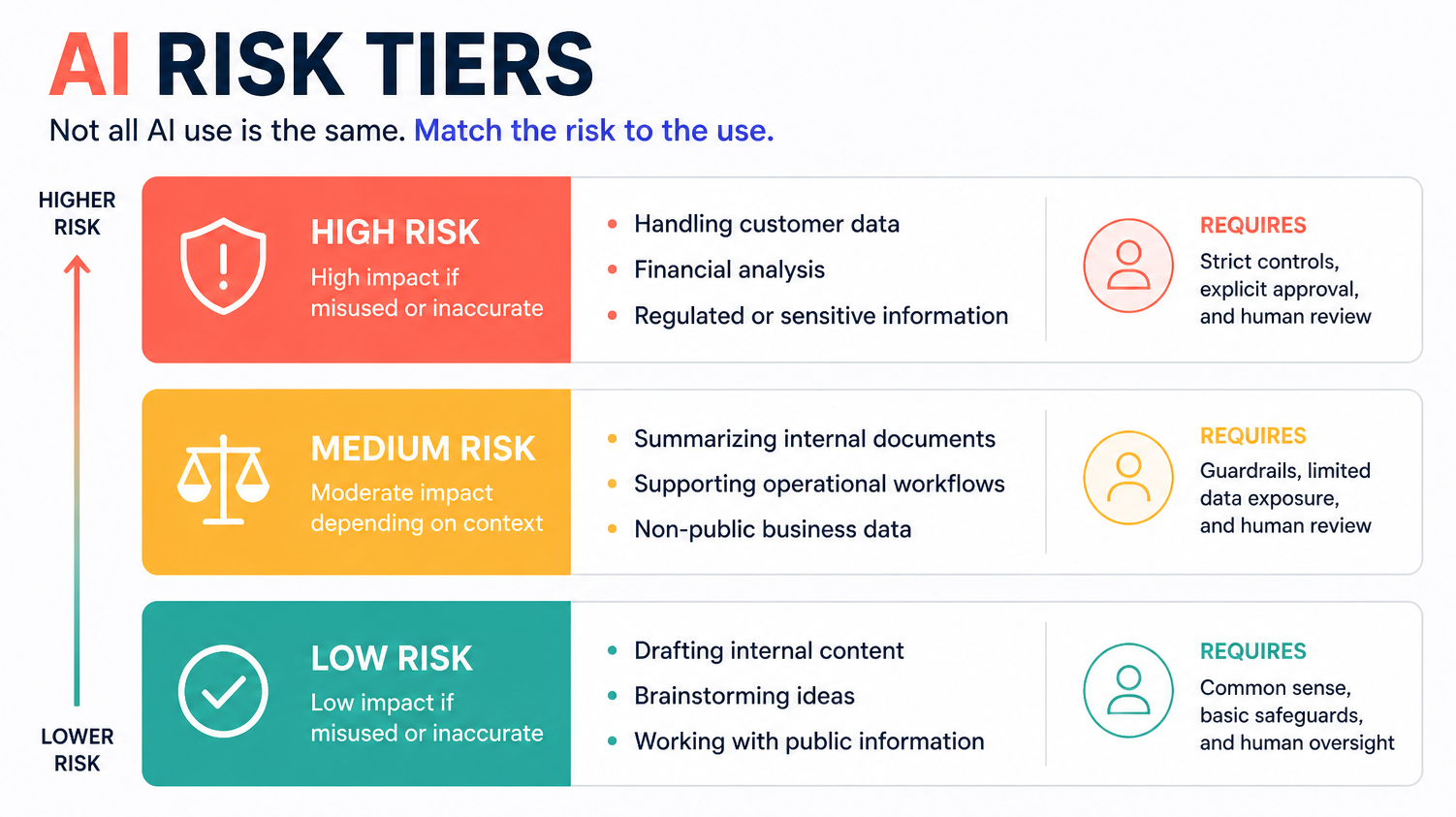
This kind of structure aligns with how mature AI environments classify risk—based on data sensitivity and impact, not just the tool itself .
The goal isn’t to eliminate risk entirely. (Wouldn’t that be nice.) It’s to make it clear enough that people can make good decisions without constantly stopping to ask for permission.
3. Include the Questions that Employees Actually Have. Then Give Them the Answers.
Most policies fail in the same way: They don’t help in the moment someone needs them.
What people really want to know is simple:
- Can I use this tool for this task?
- Can I include this data?
- Is this safe to send?
If your governance model doesn’t answer those questions quickly, it won’t be used.
That’s where clarity matters more than completeness. Instead of trying to cover every edge case, focus on the decisions that happen every day.
A strong foundation usually includes these four elements:
- A defined list of approved tools
- Clear boundaries around data usage
- Expectations for human review
- A short list of non-negotiables
One of those non-negotiables should be consistent across the board: AI output is a starting point, not a final answer. That’s why effective policies require human validation before anything is acted on or shared .
When that expectation is clear, quality doesn’t depend on chance.
4. Define Clear Roles for Ownership
Governance doesn’t fail because people disagree with it. It fails because no one owns it.
IT assumes legal is covering risk. Legal assumes IT is enforcing controls. HR is focused on communication. Meanwhile, AI adoption keeps moving forward.
To make this work, you need defined roles—but more importantly, a clear owner.
In most organizations, that looks like:
- IT leading tool evaluation, security, and enforcement
- Legal supporting with compliance and data interpretation
- HR enabling adoption through training and communication
This mirrors how formal governance models distribute accountability across teams and lifecycle stages .
The key is that someone is responsible for making the system work end to end. Without that, governance stays theoretical.
5. Think in Systems, Avoid Approvals
Approving a tool isn’t the finish line. It’s the starting point.
AI tools evolve quickly. Their features change, their data policies shift, and the way your team uses them will adapt even faster.
That’s why governance needs to follow a lifecycle, not a one-time decision.
Here’s an example lifecycle system that could work for you:
- A team identifies a new tool or use case
- The risk is evaluated based on data and impact
- The tool is approved (or not) with clear boundaries
- It’s configured to limit unnecessary exposure
- Usage is monitored over time
- Eventually, it’s updated, replaced, or retired
This approach reflects how structured AI environments manage tools from evaluation through ongoing use and monitoring .
It also keeps governance aligned with reality. Tools don’t stay static, so your approach can’t either.
6. Focus on Data, Not Just Tools
It’s easy to think governance is about which tools are allowed.
In practice, the bigger risk is how data moves through those tools.
An approved platform can still be used in a risky way. An unapproved one can feel harmless until sensitive information is introduced.
That’s why strong governance draws clear lines around data:
- Sensitive or regulated data requires explicit approval
- Internal information has defined boundaries
- Public data is treated differently from proprietary data
The policy reinforces this with strict controls around what can and cannot be submitted to AI systems .
When those boundaries are clear, people don’t need to guess. They understand the risk before they act.
7. Train for Behavior, Not Awareness
Publishing a policy doesn’t change how people work.
Training does—but only if it’s practical and ongoing.
That means moving beyond documentation and focusing on real usage:
- Showing examples of what’s allowed and what isn’t
- Tailoring guidance to different roles and teams
- Updating training as tools and risks evolve
In mature environments, this isn’t a one-time event. It’s part of how employees onboard, operate, and stay current as AI capabilities change .
Because the moment your guidance falls behind reality, people stop relying on it.
8. Be Clear About Enforcement
If governance exists only on paper, it becomes optional.
And optional policies don’t reduce risk—they create it.
Enforcement doesn’t have to be heavy-handed. It’s about aligning your systems with your decisions:
- Approved tools are accessible and supported
- Unapproved tools are restricted or monitored
- Data controls are enforced where they matter most
- Incidents have clear paths for escalation and resolution
The policy framework makes it clear that usage is monitored and violations have consequences . That’s not about punishment. It’s about consistency.
When the system behaves the same way every time, people trust it.
9. Don’t Be Afraid to Evolve
AI governance isn’t something you set once and walk away from.
New tools will emerge. Existing tools will change. Your team will find better, faster ways to use them.
The companies that stay ahead of this don’t aim for a perfect policy. They build something adaptable.
They:
- Review what’s being used regularly
- Adjust based on real-world usage
- Refine controls as risks shift
Over time, governance becomes less about restriction and more about alignment.
In Conclusion
Most companies don’t struggle because they lack a policy. They struggle because their environment isn’t built to support one.
Their tools don’t align. Their controls are inconsistent. Their teams are left to figure it out on their own.
That’s where governance starts to feel like friction instead of support.
The fix isn’t more rules. It’s a better system—one that’s tailored to your workflows, your data, and how your business actually runs.
Because there’s no universal model for this.
The right approach is always bespoke. It evolves with your technology. And it works best when it feels less like enforcement and more like partnership.
That’s when AI stops being a risk to manage—and starts becoming an advantage you can trust.